

China Best Gel Type Strong Base Anion Resin Supplier: Comparing Matrix Structures for Water Treatment
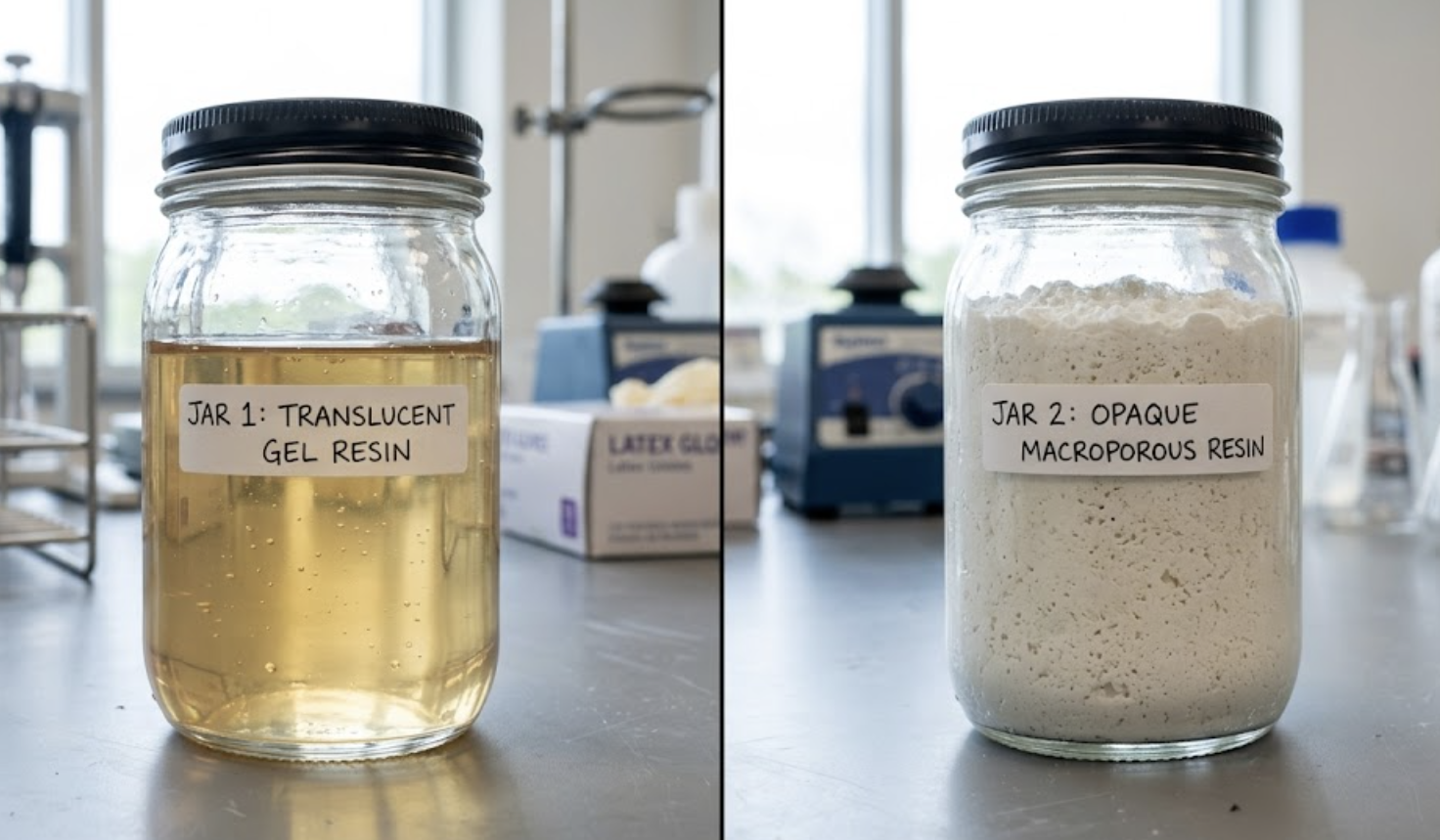

Macromolecular Matrix Architecture: Homogeneous Gel Micropores vs. Heterogeneous Macroporous Channels
Ion exchange resins consist of crosslinked synthetic polymer networks modified with active ionic functional groups. Strong base anion (SBA) resins incorporate quaternary ammonium active sites attached to a styrene-divinylbenzene (DVB) matrix. However, the internal physical structure differs fundamentally between gel-type and macroporous formulations.
Gel-type anion resins form a homogeneous polymer matrix through standard suspension polymerization without physical pore-forming agents. When dry, gel resin beads exhibit no measurable porosity. Upon hydration, water molecules cause the polymer matrix to swell, creating sub-nanometer spaces between adjacent polymer chains. These transient micro-cavities act as micropores with pore diameters typically measuring under two nanometers. Ions migrate through the hydrated gel matrix via ionic diffusion between the swollen polymer chains. This homogeneous structure allows functional groups to distribute evenly throughout the polymer sphere, maximizing active site availability for exchange reactions.
In contrast, macroporous anion resins feature a heterogeneous dual-porosity matrix. Synthetic chemists introduce phase-separating porogens into the monomer mixture during polymerization. As polymerization proceeds, the porogens create permanent, interconnected macro-reticular channels that remain intact even when the resin is completely dry. Pore diameters in macroporous resins typically range from twenty to one hundred nanometers. These broad physical channels allow rapid fluid entry and facilitate mass transfer of larger ionic complexes. However, creating permanent macro-channels reduces the density of polymer matrix per unit volume. Consequently, macroporous structures offer a lower concentration of functional quaternary ammonium groups compared to fully dense gel matrices.
Performance Trade-Off Analysis: Total Exchange Capacity, Mechanical Shock, and Pressure Drop
Choosing between gel and macroporous SBA resins involves evaluating fundamental performance trade-offs in operating exchange capacity, osmotic durability, and column hydraulics. Each matrix configuration addresses specific operational requirements in industrial water treatment systems.
Gel-type SBA resins deliver superior volumetric operating exchange capacity because the polymer network lacks artificial void spaces. The dense distribution of quaternary ammonium functional groups allows gel media to achieve operating capacities exceeding 1.0 equivalent per liter in hydroxide form and 1.3 equivalents per liter in chloride form. High active site density enables water treatment systems to process larger volumes of water per regeneration cycle. This volumetric efficiency translates directly into lower chemical regenerant consumption and smaller ion exchange vessel footprints. Furthermore, gel resins demonstrate rapid ion exchange kinetics when treating water streams free of large organic molecules.
However, the microporous nature of gel resins creates physical vulnerabilities under extreme operating conditions. Rapid changes in ionic concentration or pH cause gel polymer chains to expand and contract dramatically. This repeated swelling and shrinking generates internal osmotic stress, which can lead to bead cracking and mechanical breakdown over time. Additionally, high flow velocities or rapid backwashing can compress gel beds, leading to increased hydraulic pressure drop across the resin vessel.
Macroporous SBA resins exhibit exceptional mechanical strength and resistance to osmotic-temperature shock. The rigid macro-reticular matrix absorbs physical stresses caused by rapid concentration swings without fracturing polymer beads. The open porous network also maintains structural integrity during high-flow operation, preventing bed compaction and preserving stable pressure drop profiles. Despite these mechanical advantages, macroporous resins yield lower total exchange capacity per unit volume due to their internal macro-voids. Water plant operators must balance the higher physical durability of macroporous resins against the superior volumetric efficiency and lower regeneration costs of gel-type media.
Reversible Kinetics and Organic Fouling Resistance: Mitigating Degradation in Challenging Waters
Organic fouling represents one of the most severe operational challenges for strong base anion exchange media in water demineralization systems. Naturally occurring organic matter, including humic acids and fulvic acids, carries negative electrical charges and competes with mineral anions for exchange sites on SBA resins.
When organic molecules enter a gel-type anion resin, their large molecular size hinders mobility within the tight microporous network. The organic ions diffuse slowly into the swollen polymer matrix and adsorb strongly onto quaternary ammonium functional groups. During standard chemical regeneration using sodium hydroxide, these large organic compounds fail to desorb efficiently from the narrow micropores. Over consecutive operating cycles, accumulated organic foulants block active exchange sites and restrict ionic diffusion pathways. This irreversible organic fouling leads to premature silica leakage, reduced operating capacity, and increased rinse water requirements. Therefore, standard gel resins suit raw water sources with low total organic carbon levels, typically below two parts per million.
Macroporous SBA resins provide superior organic fouling resistance due to their spacious internal pore architecture. Large humic and fulvic acid molecules easily navigate the broad macro-reticular channels to access active functional sites. During caustic regeneration, the open channel network allows regenerant solutions to penetrate deeply and strip adsorbed organic foulants effectively. The reversible kinetics of macroporous matrices prevent organic accumulation, maintaining stable ion exchange performance in high-TOC feedwater applications.
Understanding these interaction mechanisms allows process engineers to deploy specialized separation strategies. Advanced industrial processes often utilize functional resin technology to address complex purification challenges where standard media face rapid degradation. Deploying macroporous organic scavengers upstream of high-capacity gel resins effectively shields downstream demineralization units from organic fouling while preserving system operating capacity.
Precision Polymerization Control: How Sunresin Standardizes Matrix Integrity Across Commercial Batches
Achieving reliable performance in commercial water treatment requires strict consistency during industrial resin synthesis. As a global pioneer in separation technology, Sunresin(Sunresin New Materials Co. Ltd.) operates advanced automated manufacturing hubs in Gaoling and Pucheng with an annual production capacity reaching 100,000 cubic meters. The manufacturer applies rigorous quality control protocols across every phase of resin production.
Precise control of suspension polymerization is essential for producing high-quality gel and macroporous SBA resins. Sunresin monitors temperature profiles, agitation kinetics, and chemical dosing in real time to ensure uniform crosslinking density and precise control over divinylbenzene content. Controlling polymer crosslinking prevents excessive swelling and guarantees optimal physical bead strength. Furthermore, advanced classification technology yields a narrow particle size distribution with high whole bead counts, typically exceeding ninety-five percent. Uniform bead sizes prevent column channeling, reduce hydraulic head loss, and ensure even regenerant flow distribution during operation.
To verify quality before product dispatch, dedicated quality assurance teams evaluate every production lot using sophisticated analytical tools. Chemists utilize gas chromatography-mass spectrometry and inductively coupled plasma optical emission spectrometry to confirm chemical purity and eliminate trace organic leachates. Physical testing protocols include automated bead integrity counting, osmotic-temperature shock cycling, and dynamic exchange capacity evaluation. Operating under ISO 9001 and ISO 14001 certified management systems, Sunresin New Materials Co. Ltd. guarantees that commercial shipments maintain identical performance specifications to laboratory standards, providing global utilities with fully traceable, high-reliability separation media.
Engineering Selection Framework: Matching Feedwater Parameters with SEPLITE® SBA Matrix Options
Selecting the ideal ion exchange media requires a systematic evaluation of raw water chemistry, operating parameters, and effluent quality requirements. Process engineers must analyze key feedwater metrics, including total dissolved solids, total organic carbon, silica levels, and operating temperature, before specifying resin matrix structures.
For standard industrial demineralization and drinking water purification where feedwater total organic carbon remains low, gel-type SBA resins represent the most cost-effective choice. Products such as SEPLITE® gel strong base anion resins deliver maximum operating capacity, excellent regeneration efficiency, and reliable nitrate or sulfate removal. The high volumetric capacity minimizes vessel sizing and lowers ongoing chemical consumption. In contrast, when treating surface water supplies or industrial effluents containing elevated organic concentrations, engineers should specify macroporous SBA resins or implement a dual-bed system featuring an organic scavenger guard vessel.
Engineering contractors and system integrators benefit from comprehensive technical support when designing custom water treatment plants. Sunresin combines certified polymer manufacturing with specialized equipment engineering, pilot testing facilities, and turnkey EPC project support. Technical specialists analyze site-specific water profiles and conduct laboratory feasibility studies to recommend optimal media configurations. Supported by an international logistics network, including European regional centers in Düsseldorf, Sunresin ensures rapid delivery of certified SEPLITE® resins to project sites worldwide. By matching advanced polymer matrix engineering with localized technical expertise, Sunresin empowers water treatment operators to optimize system performance, ensure regulatory compliance, and lower total cost of ownership.
To explore technical data sheets, request product samples, or consult with water treatment application specialists, visit the official corporate website at https://www.seplite.com/.
Sunresin New Materials Co. Ltd.
Sunresin New Materials Co. Ltd.
+ +86 29 8669 1600
email us here
Legal Disclaimer:
EIN Presswire provides this news content "as is" without warranty of any kind. We do not accept any responsibility or liability for the accuracy, content, images, videos, licenses, completeness, legality, or reliability of the information contained in this article. If you have any complaints or copyright issues related to this article, kindly contact the author above.
