

Ah-scale pouch cells enabled by stress-free magnesium anodes: A breakthrough toward commercial rechargeable Mg batteries
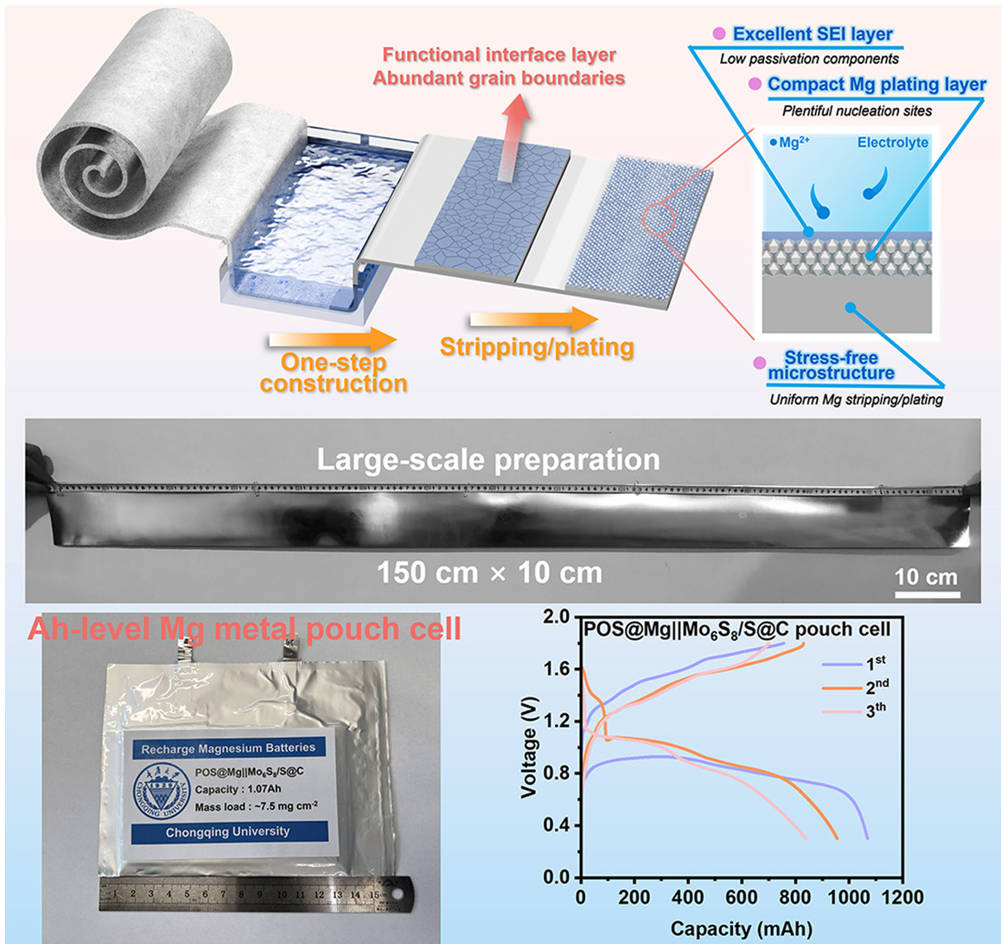
One-step protonated organic solvent treatment enables stress-free magnesium anode for Ah-level pouch cells.
GA, UNITED STATES, July 16, 2026 /EINPresswire.com/ -- Rechargeable magnesium batteries promise higher volumetric capacity and greater resource abundance than lithium-ion systems, yet their anodes have been crippled by native oxide layers and uneven stripping/plating that shorten cycle life and prevent scale-up. Researchers have now developed a simple protonated organic solvent treatment that removes the surface oxide, forms a functional magnesium ethoxide interlayer, and relieves surface stress while preserving the anode's original microstructure. The result: symmetric pouch cells that cycle for over 4,000 hours and the world's first 1.07 ampere-hour (Ah) multilayer magnesium pouch cell, marking a critical step toward commercial-scale rechargeable magnesium batteries.
The native oxide film (MgO and Mg(OH)₂) that forms on magnesium metal in air or during processing repeatedly ruptures and reforms during battery operation, causing non-uniform deposition, low coulombic efficiency, and rapid failure. Traditional approaches — mechanical grinding, polishing, and acid treatments — either introduce stress concentrations and defects into the microstructure or remain confined to small-format coin cells. Grinding-induced stress layers can reach 30 micrometers in depth, creating preferential corrosion sites that accelerate degradation. Meanwhile, acid-based methods have struggled to simultaneously address interface chemistry and bulk microstructure in a way that scales to practical cell formats. Based on these challenges, a practical approach capable of stabilizing both the anode interface and the microstructure in a scalable manner is urgently needed.
Researchers from Chongqing University and Xiamen University report (DOI: 10.1016/j.esci.2026.100609) in eScience (online June 19, 2026) that a protonated organic solvent treatment — using hydrochloric acid and ethanol — transforms the magnesium anode surface by replacing the native oxide layer with a magnesium ethoxide (Mg(C₂H₅O)₂) interlayer while preserving a stress-free microstructure. This dual modification enables uniform magnesium stripping and plating, delivering unprecedented cycling stability and the first demonstration of Ah-level performance in a multilayer pouch cell.
The team systematically screened acids and solvents and selected hydrochloric acid in ethanol to treat large-format magnesium foils — achieving batch-processed anodes up to 150 cm × 10 cm in size. Transmission electron microscopy revealed that the native 4.6 nm MgO layer was replaced by an 8.5 nm magnesium ethoxide layer. Nuclear magnetic resonance spectroscopy confirmed the Mg–O–C bonding, while electron backscatter diffraction showed that the treated anodes retained a stress-free microstructure— in stark contrast to mechanically ground anodes, which exhibited stress-concentrated layers approximately 30 μm deep with an average kernel average misorientation (KAM) value of 2.05 versus only 0.18 for the treated anodes.
During cycling, the time-of-flight secondary ion mass spectrometry (TOF-SIMS) showed magnesium ethoxide interlayer decomposes and participates in forming a solid electrolyte interphase (SEI) with significantly lower levels of passivating MgO and Mg(OH)₂ components. Density functional theory (DFT) calculations further revealed that magnesium atoms preferentially strip and plate at grain boundaries, where the dissociation energy is 0.73 eV compared to 1.58 eV on grain interiors, and adsorption energy is −1.24 eV versus −0.85 eV. This grain-boundary-guided mechanism, combined with the low-passivation SEI, enabled uniform deposition without dendrites.
“The key insight here is that you can't just fix the surface — you have to address the microstructure underneath,” the authors said.“Our treatment does both in one simple step: it clears away the problematic oxide, builds a functional interlayer that evolves into a better SEI, and leaves the metal's grain structure intact so that grain boundaries can do their job as natural nucleation sites. We were surprised to see symmetric pouch cells run for over 4,000 hours, and building a 1.07 Ah multilayer cell — the largest reported for magnesium — really convinced us this approach can scale.”
This work directly addresses the manufacturing bottleneck that has kept magnesium batteries in the laboratory. The simple immersion-based treatment is compatible with roll-to-roll processing, making it industrially viable for large-scale anode production. When paired with Chevrel-phase Mo₆S₈ cathodes, the treated anodes delivered 1,500 cycles with 79.8% capacity retention at 0.5 C — far outperforming ground anodes which retained only 14.4%. The Ah-level pouch cell, stacking five cathode sheets and three magnesium foils, achieved 1.07 Ah initial capacity and maintained stable operation over 50 cycles. Beyond grid storage and electric transportation, this breakthrough could accelerate the commercialization of rechargeable magnesium batteries as a safer, more sustainable alternative to lithium-ion systems.
References
DOI
10.1016/j.esci.2026.100609
Original Source URL
https://doi.org/10.1016/j.esci.2026.100609
Funding information
The work was supported by the National Key R&D Program of China (No. 2023YFB3809500), the Chongqing Technology Innovation and Application Development Project (No. 2024TIAD-KPX0003), and the Xiaomi Young Talents Program.
Lucy Wang
BioDesign Research
email us here
Legal Disclaimer:
EIN Presswire provides this news content "as is" without warranty of any kind. We do not accept any responsibility or liability for the accuracy, content, images, videos, licenses, completeness, legality, or reliability of the information contained in this article. If you have any complaints or copyright issues related to this article, kindly contact the author above.
